How Virtual Tours Improve SEO and Customer Engagement
Virtual tours increase dwell time, engagement and conversions — and they strengthen local SEO through Google Business Profile. Here is exactly how the SEO benefits work, and how to measure them.
Key Takeaways
- Tours multiply dwell time - visitors explore instead of skim-and-leave.
- A tour on your Google Business Profile strengthens local search presence.
- Engaged visitors convert - in-tour lead capture turns exploration into enquiries.
- Tours earn links and social shares that photo galleries never do.
- Track tour engagement alongside rankings - scenes viewed, time inside, leads captured.
Most virtual tour marketing focuses on the experience: buyers exploring rooms, guests checking suites. This article is about the quieter payoff — what a tour does for your search visibility and conversion rates. The mechanisms are real, measurable and mostly misunderstood.
(Background on the medium itself lives in our ultimate guide to virtual tours.)
The honest version of "tours help SEO"
Let's be precise, because this topic attracts snake oil: there is no direct ranking boost for having a virtual tour. Google does not check for tours and move you up three places.
What tours do is improve the behavioural signals that search engines demonstrably respond to, and open a local SEO channel most competitors ignore. Indirect, but powerful — like hiring a great chef doesn't directly improve restaurant reviews, yet somehow the reviews improve.
Mechanism 1: Dwell time and engagement
When a visitor clicks your search result, looks for eight seconds and returns to Google, that "pogo-stick" behaviour tells the algorithm your page did not satisfy the query. When they stay four minutes, the opposite.
A virtual tour is the strongest dwell-time asset a page about a physical space can have, because it converts reading into doing. Visitors click into the tour, look around, move rooms, open hotspots — sessions on pages with tours run several times longer than photo-gallery equivalents, and those visitors come back (often with a partner or colleague) for repeat visits.
The interactivity is the whole trick — a video produces nothing comparable, because watching is passive and finite.
Mechanism 2: Local SEO and Google Business Profile
For any business with premises — agencies, hotels, venues, clinics, showrooms — the map pack is where local customers actually decide, and Google Business Profile is its engine.
GBP supports 360 photos and virtual tour content, and profiles rich with visual content earn measurably more direction requests, calls and website clicks. The playbook:
- Upload 360 photos of your premises directly to your profile.
- Link your full virtual tour from your website's landing pages and GBP posts.
- Keep it fresh — updated visual content signals an active business.
Since competitors' profiles mostly hold a logo and four phone snaps, a full interactive tour is cheap differentiation in the exact surface where "estate agent near me" gets decided. This works identically for every premises-based sector in our industry breakdown.
Mechanism 3: Links and shares
Search engines still weigh links heavily, and tours earn them the way good content always has — by being worth pointing at. Local news covering a notable property, a wedding blog embedding a venue's ballroom tour, a university's campus tour shared across student forums: these are natural links that a photo gallery never attracts. The world's best tours are shared millions of times for exactly this reason.
Mechanism 4: Conversion — engagement becoming enquiries
Rankings are means; enquiries are ends. Tours convert the attention they capture:
- Qualified leads. Someone who explored a property in full and then enquired is a warm prospect. Viewings booked after tours convert at far higher rates, and time stops being wasted on mismatched expectations.
- In-tour lead capture. The Estate Agent viewer style puts enquiry forms and CTAs inside the tour — catching interest at its peak, not hoping the visitor finds your contact page later.
- Hotspot pathways. Interactive hotspots link directly to booking pages, brochures and product pages, shortening the path from interest to action.
Doing it right: technical checklist
A tour only helps SEO if it is implemented well. The short list:
- Lazy-load embeds. A poster image first, full tour on click — page speed scores stay intact. (360tours.studio embeds work this way.)
- Embed on the page that should rank — the listing, the venue page, the location page — not on an orphaned "virtual tour" page nobody links to.
- Surround it with real content. The tour deepens a good page; it does not replace descriptions, headings and structured data.
- Share one canonical link everywhere — website, portals (Rightmove accepts tour links), GBP, email and social — so engagement concentrates rather than fragments.
A worked example: one agency, one experiment
To make the mechanisms concrete, here is the experiment we recommend every premises-based business run — and what typically happens.
An independent estate agency embeds tours on half its live listings (say 15 of 30), matched roughly for price band and property type, and changes nothing else for thirty days. The pattern that emerges, consistently:
- Time on page on tour listings runs several multiples of the photo-only listings — minutes instead of seconds.
- Enquiry rates on the tour listings rise noticeably, and — the part agents care about — the enquiries are better: viewers have already seen the whole property, so viewing-to-offer conversion improves while no-shows fall.
- Return visits appear in analytics as buyers come back with partners in the evening — sessions the photo listings simply never generate.
- Portal performance improves too, since Rightmove and Zoopla surface listings with virtual tour badges to filtered searches.
The thirty-day comparison also produces the artefact that matters internally: a one-page number-versus-number case for rolling tours out across all stock, which is a much easier conversation than "the internet says tours are good".
Measuring it: the metrics that matter
Run it like an experiment, not an act of faith:
| Metric | Where | What it tells you |
|---|---|---|
| Time on page | Your analytics | Is the tour holding attention? |
| Bounce rate | Your analytics | Are visitors engaging or leaving? |
| Enquiry rate per page | Your CRM | Tour pages vs non-tour pages |
| Tour views & scenes explored | Tour analytics | Which spaces interest people |
| Time inside tour | Tour analytics | Depth of evaluation |
| In-tour leads | Tour platform | Direct conversion attribution |
| GBP actions | Business Profile | Local visibility converting |
360tours.studio includes tour analytics on paid plans — scene-level engagement and lead tracking — so the ROI conversation is numbers, not vibes. See what's included.
The compounding effect
Each mechanism feeds the next: better engagement supports rankings, better rankings bring more visitors, tours convert more of them, and the enquiries justify tours on more pages. Businesses that embed tours across their listings and premises pages build an advantage that a competitor cannot copy with a weekend content sprint.
Start with one page and measure. Create a tour, embed it where the decision happens, and compare thirty days of data — try the demo first if you want to feel what your visitors will. For everything else the medium can do, the ultimate guide to virtual tours is the hub.
Frequently Asked Questions

The 360tours.studio Team
Virtual Tour Experts
We build interactive 360 virtual tour software for estate agents and property marketers.
Related Articles
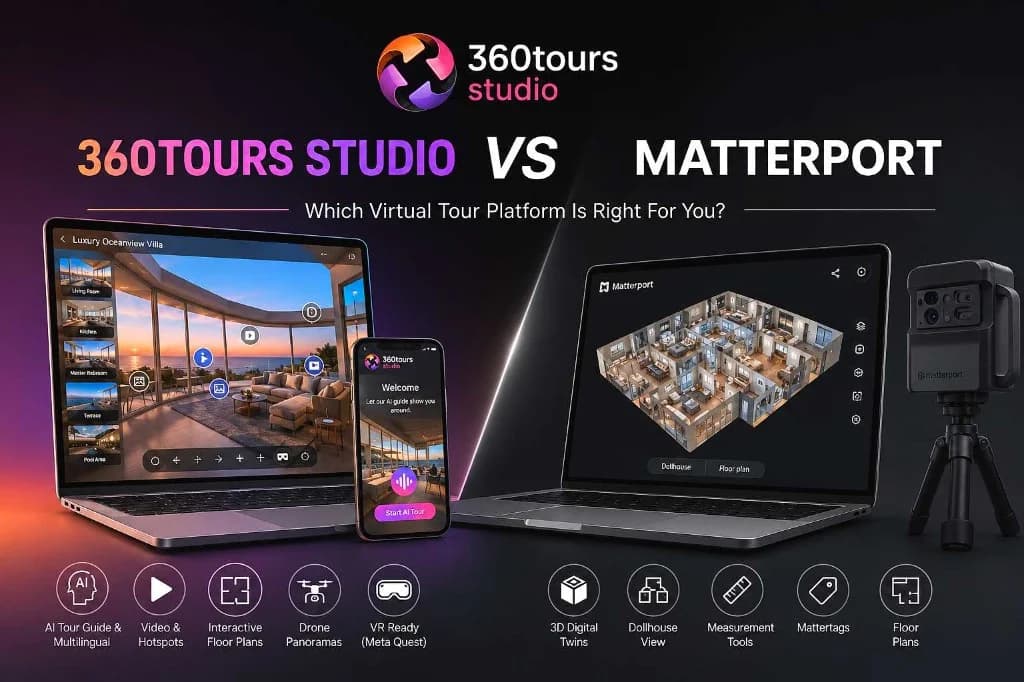
360Tours Studio vs Matterport: Which Virtual Tour Platform Is Best?
Comparing 360Tours Studio and Matterport: digital twins vs interactive 360 experiences, image quality, AI features, branding, capture speed and which platform fits marketing, education, tourism and property.
The Ultimate Guide to Virtual Tours (2026)
Everything you need to know about virtual tours: what they are, how they work, the technology behind them, the industries using them, and where AI and VR are taking immersive experiences next.
What Is a Virtual Tour? A Complete Beginner's Guide
New to virtual tours? This beginner's guide explains exactly what a virtual tour is, how 360 photos, hotspots, floor plans, audio and VR fit together, and how to view or create your first one.